

Nobody buys a lab-tested botanical extract and then thinks carefully about where to put it. It goes in the bathroom cabinet, or the kitchen shelf above the stove, or the car, and then six months later somebody wonders why it does not seem to be doing much. Indian weather has opinions about all three of those choices.
Kushiva makes AYUSH-licensed cannabis leaf extract in four formats, from Rs 1,199, with a certificate of analysis behind every batch.See the range
This guide covers what actually degrades cannabis leaf extract, why Indian heat and monsoon humidity make it a real question rather than a fussy one, where to keep it, and how to tell when a bottle is past its useful life.
This article is general information, not medical advice. Vijaya (cannabis leaf extract) is prescription-regulated in India and should be used only under the supervision of a registered medical practitioner. Nothing here sets a dose: how much is right for you depends on your prescription, the strength of the product, your health condition, how your body responds, and any other medicines you take. That is a conversation with your doctor, not a website.
Key takeaways
- Three things degrade cannabis oil: light, heat and oxygen. Your storage job is to limit all three.
- Cool, dark, dry, tightly closed, upright. A cupboard in the coolest room beats anywhere clever.
- The three worst spots in an Indian home are the car, the bathroom cabinet and the windowsill.
- The fridge is usually unnecessary and sometimes counterproductive. Follow the pack label.
- Storage is also a child-safety matter, and that outranks potency every time.
Quick answer
Store cannabis leaf extract oil somewhere cool, dark and dry, tightly capped, upright, and well out of reach of children. Keep it away from direct sunlight, away from heat sources, and out of the bathroom. Follow the storage line printed on your pack, use it within the printed expiry, and do not leave it in a car. That is genuinely most of it.
What actually degrades cannabis oil
Cannabinoids are not delicate exactly, but they are not indestructible either. Three things break them down, and they compound:
- Light. Ultraviolet light drives photodegradation. This is why serious products ship in amber or opaque glass rather than clear bottles, and why a windowsill is a slow-motion disaster.
- Heat. Warmth accelerates the whole process, and Indian summers are not a hypothetical.
- Oxygen. Every time the bottle sits open, oxidation gets a turn. Cap it properly.
A four-year study in Forensic Science International tracked cannabis samples under different conditions and found that degradation was faster in the first year, and markedly worse for samples exposed to light at room temperature than for those kept dark and cool. The first year is where you lose most of what you are going to lose, which is a good argument for buying what you will actually use.
The three worst places in an Indian home
With apologies, because everyone does at least one of these:
- The car. A parked car in an Indian summer is an oven with upholstery. This is the single fastest way to degrade a bottle, and depending on where you are driving, an open container in a vehicle is a conversation you do not want.
- The bathroom cabinet. It feels like the medicine place. It is also the hottest, most humid room in the house several times a day. Every steamy shower is a small assault on the cap seal.
- The kitchen shelf near the stove. Convenient, warm, and directly above a heat source. Pick a different shelf.
The honourable mention goes to the sunny windowsill, which manages to combine light and heat in one elegant package.
So where should it go?
A cupboard or drawer in the coolest room of the house, away from windows and appliances, with the bottle upright and the cap tight. Bedroom cupboards usually beat kitchens. If you have air conditioning in one room, that room wins.
Keep it in its original packaging. The box is not just branding, it is another layer between the contents and the light, and it keeps the batch number and expiry date with the product where you can find them.
Does cannabis oil need to go in the fridge?
Usually not, and the pack label is the authority here rather than the internet. Refrigeration adds two small problems: oils can thicken and become harder to dose accurately from a dropper, and moving a cold bottle in and out of a humid Indian kitchen invites condensation inside the container, which is the opposite of what you want.
Cool and stable beats cold and cycling. If your pack says refrigerate, refrigerate.
Gummies have their own rules
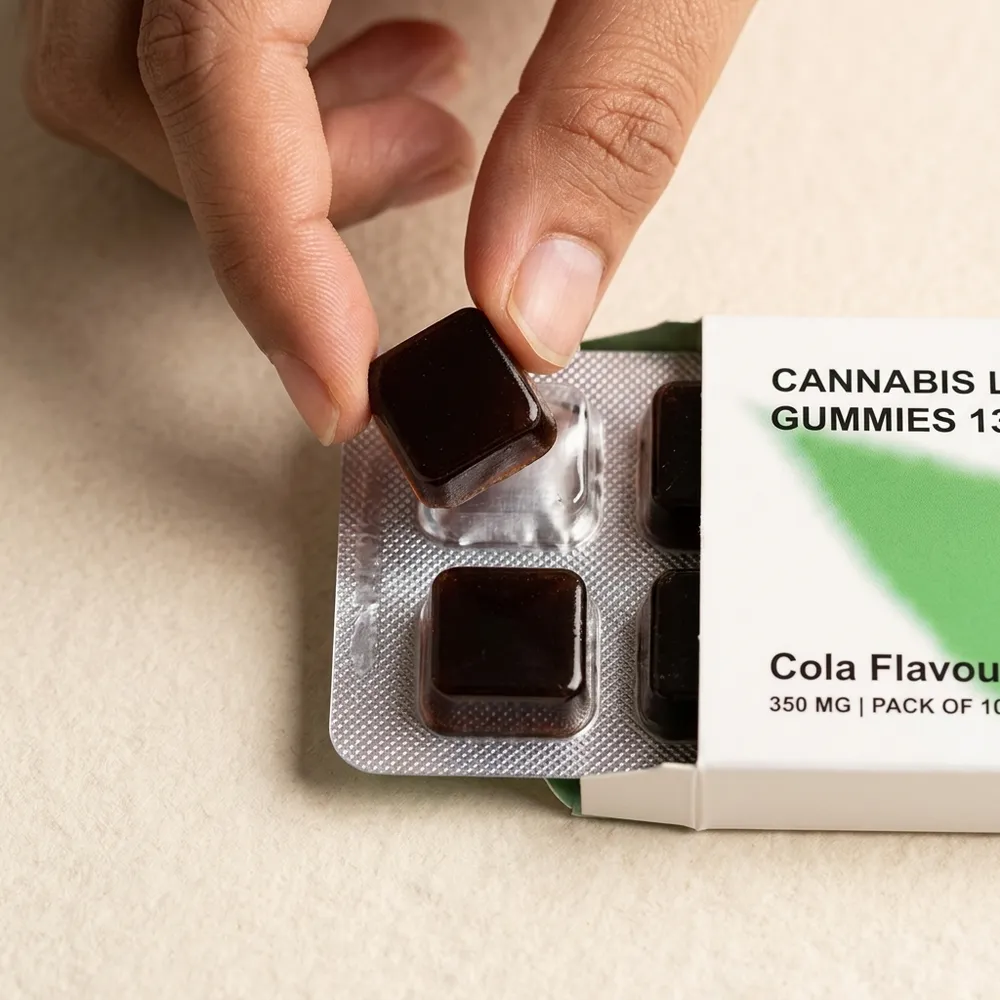
Edibles care more about humidity than oils do. Heat makes them tacky and monsoon humidity makes them stick together, which is irritating but also makes it harder to see what you are taking. Keep the pack sealed, cool and dry, and do not decant them into an unlabelled jar. An unlabelled jar of cola-flavoured gummies in a shared kitchen is exactly the accident you are trying to avoid. There is more format detail on the cannabis gummies collection page.
Child safety outranks everything above
Everything before this section is about protecting the product. This section is about protecting a person, so it wins. These products must be stored out of reach and out of sight of children, and preferably somewhere that locks.
The specific hazard with edibles is that they do not read as medicine. A gummy looks like a sweet because it is shaped like one. Keep it in its original labelled packaging, keep it high, and treat it the way you would treat any prescription medicine in a house with children. More in our responsible use rules.
How to tell a bottle is past it
Check the printed expiry date first, and do not use it past that. Beyond the date, the practical signs are a noticeably changed smell, a change in colour or clarity, or a texture that has gone thick or gritty. Cannabis extract in a carrier oil can shift over time; a dramatic change is a reason to stop, not to push on.
If you want to know what the contents looked like at the start, that is what the batch certificate of analysis records, and ours are on the lab results page. A COA describes the batch as tested, not the bottle as stored. Storage is the part you own.
Frequently asked questions
How should cannabis oil be stored in India?
Cool, dark, dry, tightly capped and upright, in its original packaging, away from direct sunlight and heat sources, and out of reach of children. Avoid the car, the bathroom and any shelf near the stove.
Does cannabis leaf extract oil need refrigeration?
Usually not. Follow the storage line on your pack. Refrigeration can thicken the oil and invite condensation inside the bottle when it moves between cold and humid air.
Does cannabis oil expire?
Yes. There is a printed expiry date on the pack and you should not use it past that. Potency also declines gradually with light, heat and oxygen exposure, with most of the loss in the first year.
How should cannabis gummies be stored?
Sealed, cool and dry, in the original labelled pack. Humidity makes them stick together, and decanting them into an unlabelled container removes the one thing that tells everyone in the house what they are.
Does bad storage make cannabis oil unsafe?
The bigger practical risk is that it stops matching its label, so what you take is no longer what your prescription assumed. If a product has changed noticeably in smell, colour or texture, stop and speak to your doctor.
The bottom line
Light, heat and oxygen are the enemies; a cool dark cupboard defeats all three. Keep the bottle in its box, keep the cap tight, keep it away from the car and the bathroom, and keep it where a child cannot reach it. Do that and the product you take in month six is close to the one described on the lab report. You can see what we make, with prices and batch reports, on the shop page.
From Kushiva
Lab-tested, licensed, doctor-reviewed.
Four cannabis leaf extract products, every price listed, every batch backed by a certificate of analysis. An in-house doctor reviews each order before it is dispatched, at no extra cost.
Related from the Kushiva Journal
This article is general information, not medical advice. Vijaya (cannabis leaf extract) is prescription-regulated in India and should be used only under the supervision of a registered medical practitioner. Nothing here sets a dose: how much is right for you depends on your prescription, the strength of the product, your health condition, how your body responds, and any other medicines you take. That is a conversation with your doctor, not a website.