
A laboratory report answers specific questions about a sample. Learning which questions it answers is more useful than looking for a large potency number or a reassuring seal.
Kushiva makes AYUSH-licensed cannabis leaf extract in four formats, from Rs 1,199, with a certificate of analysis behind every batch.See the range
This article is general information, not medical advice. Vijaya (cannabis leaf extract) is prescription-regulated in India and should be used only under the supervision of a registered medical practitioner. Nothing here sets a dose: how much is right for you depends on your prescription, the strength of the product, your health condition, how your body responds, and any other medicines you take. That is a conversation with your doctor, not a website.
Key takeaways
- Check the batch code on the report against the pack before you read a single number.
- Extract quantity is not cannabinoid content. Milligrams of extract per ml tells you nothing about CBD or THC.
- ND is not zero. It means below the laboratory's detection threshold, which the report should state.
- A potency test is not a contaminant screen. Ask which panels were actually run.
- A clean report describes composition. It cannot establish that a preparation works for a condition.
Quick answer
What is a cannabis COA? A certificate of analysis records test results for an identified sample. Read its batch details, named tests, units, methods and limitations together. A cannabinoid result does not establish that pesticides were tested, and a passing laboratory result does not establish a treatment benefit.
Start with identification, not the result
Before interpreting a number, compare the product name and batch or lot code on the report with the package. Also check what was sampled: a raw ingredient, an oil before filling, or the finished preparation. A report for an ingredient should not silently be treated as a report for every later finished batch.
Look for a sample identifier, the laboratory's identity, the dates of sampling or receipt and analysis, and the report's issue date. Where a field is missing, ask for clarification rather than filling in the gap yourself. A clear photograph of the package and the complete report are more useful for this purpose than a cropped screenshot of a single result.
Sampling matters because a laboratory measures the material it receives. California's Department of Cannabis Control publishes a representative-sampling checklist, illustrating that batch identification and sampling controls are separate from the analytical instrument. This is an example of laboratory practice in another jurisdiction, not a statement of Indian legal requirements.
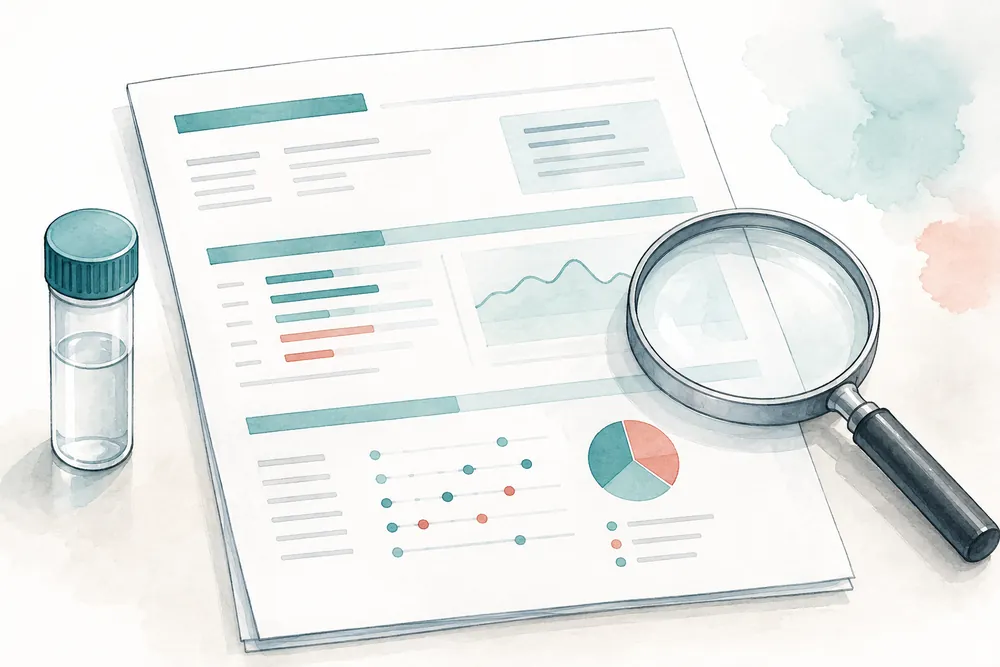
Extract quantity is not the same as CBD or THC content
Cannabis leaf extract is a mixture. A quantity of that mixture cannot automatically be read as the same quantity of CBD, THC or total cannabinoids. For background terminology, see the site's explanation of cannabis leaf extract, CBD oil and hemp seed oil. That page provides context; the particular batch report remains the document to interpret.
| Statement | What it tells you | What remains unknown |
|---|---|---|
| Leaf extract per ml | The declared amount of the mixture in a volume | Individual CBD and THC amounts |
| CBD detected | The identity test found evidence of CBD | A reliable numerical CBD concentration |
| CBD measured in mg/g | CBD mass relative to sample mass | Amount per ml without suitable density information |
| Contaminant panel passed | The listed tests met the stated limits | Anything outside that panel |
A fictional arithmetic example: suppose a label declares 120 mg of leaf extract per ml. A 15 ml container would contain 1,800 mg of declared extract. Multiplying those two numbers does not reveal the CBD or THC content. That requires a cannabinoid-specific measurement. These invented figures explain units only; they are not a product specification or a dosing example.
Check whether a percentage is mass by mass or mass by volume. A result in mg/g and a result in mg/ml have different denominators. They cannot be treated as interchangeable merely because both appear on oil products. If the report includes a calculated total, ask which measured compounds and calculation the laboratory used.
NIST's first Cannabis Quality Assurance Program report examined measurements of several cannabinoids in hemp oils, including separate acid and neutral forms and calculated totals. The programme exists to improve measurement comparability. This is why a named result and its method matter more than a generic claim that something was tested.
What do ND, LOD and LOQ mean?
These abbreviations describe the limits of a measurement. Read the laboratory's own definitions because reporting conventions differ.
- LOD, limit of detection: a threshold associated with detecting an analyte using the stated method.
- LOQ, limit of quantification: a threshold above which the laboratory can report an amount with its specified quantitative performance.
- ND, not detected: generally a result below the report's detection threshold. It does not establish absolute zero.
- Below LOQ: the result is below the stated quantification threshold; do not turn it into an exact concentration.
NIST's 2024 interlaboratory report explicitly distinguishes results reported below a laboratory's quantification limit and discusses uncertainty and reference materials. A measurement has boundaries. A report that makes those boundaries visible is giving you information needed to interpret the result.
For example, a blank cell, ND and a numerical zero should not be assumed to mean the same thing. Ask whether a blank cell means not requested, not tested, not applicable or not reported. If a clinician needs a concentration that the report cannot quantify, the uncertainty should be disclosed to them.
A potency test is not a contaminant screen
A useful way to read a COA is to list its panels separately. Cannabinoid analysis, residual solvents, pesticide residues, heavy metals, microbial impurities and mycotoxins address different questions. The California testing-laboratory overview lists these categories independently. Its requirements apply there; they should not be presented as India's universal testing standard.
Look at what was tested, the actual result, the relevant reporting unit and the criterion used to determine pass or fail. A pass is relative to a stated test and threshold. It is not a universal declaration that a preparation is safe for every person, in every circumstance, indefinitely.
Also distinguish manufacturer-issued quality-control documentation from an independent laboratory report. Neither the word certificate nor the presence of a logo establishes independence. Ask who performed the work. Where accreditation is claimed, ask for the current scope covering the relevant methods and sample type, rather than relying on the logo alone.
A practical request for missing information
The following is an original request template, not a checklist of statutory obligations:
Please send the complete report for the batch shown in the attached label photograph. Could you identify the sample tested, the testing laboratory, and the test dates? Please clarify whether the report quantifies individual cannabinoids or confirms identity only, which contaminant panels were performed, and the meaning of any ND or below-LOQ entries.
Keep the response with the report. An unresolved discrepancy is a reason to seek clarification, not an invitation to calculate a missing result from promotional copy. If a QR code opens a document, compare the identifiers after opening it; the existence of a working code does not authenticate the contents.
Kushiva's lab-results information page is the relevant internal starting point for its document process. This article does not independently verify a Kushiva batch or certify that particular testing has occurred.
Frequently asked questions
Does a COA prove that a preparation treats a condition?
No. Laboratory composition and clinical effectiveness are different questions. Evidence about patient outcomes needs an appropriate clinical study, not just a chemical analysis.
Does a positive CBD identity test tell me how much CBD is present?
No. Identification and quantification are different analytical claims. Look for a numerical cannabinoid result, its unit and the method's reporting limits.
Does not detected mean completely absent?
Not necessarily. The meaning depends on the laboratory's detection threshold and reporting convention. Ask for those details if the distinction affects a medical or other important decision.
Can I compare two reports with different units?
Only after the quantities and denominators are understood. Ask the laboratory to explain any required conversion. Do not use uncertain conversions to make dosing decisions.
Who can help interpret a confusing result?
The issuing laboratory can explain the measurement. A qualified clinician or pharmacist can consider what the available information means for your care. Neither role should be replaced by an automated potency calculator.
Keep the document and the decision separate
The most useful outcome of reading a COA is a precise statement of what is known and what is missing. Record the batch, the named measurements and any unanswered questions. A report can inform a conversation about a preparation; it cannot make the clinical decision for you.
From Kushiva
Every batch has a certificate of analysis.
Four cannabis leaf extract products, every price listed, every batch backed by a lab report you can read with the guide above.